

The key to sustainable agriculture
The year 2026 placed unprecedented demands on the agricultural sector, demonstrating that the climate crisis is no longer a distant future scenario. Extreme drought, heat, and other extreme weather events force farmers to consider how agriculture can function under increasingly unpredictable production conditions. Farmers involved in the "Farming for Nature" initiative offer three concrete strategies.
Nature as Inspiration
For vegetable farmer Silvia Fruhmann, nature is not merely a basis for production but also a source of inspiration. With rainfall on her farm in Central Burgenland down by around 50 percent—and no well available in the fields—effective water management is crucial for her. In seeking ways to protect the soil, she looked to a principle the forest has mastered for millennia: keeping the ground covered at all times. A mulch layer of clover and alfalfa shields the soil in her vegetable fields from direct sunlight, reduces evaporation and creates conditions that protect microorganisms and other forms of soil life. She also recently explained to Chris Cummins on the FM4 Morning Show why she nourishes her vegetable plants with homemade herbal teas.
Restoring Habitats
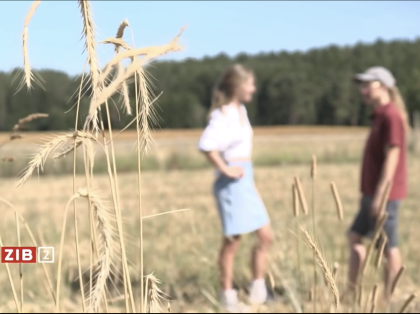
In the Waldviertel region, arable farmer Irene Lüdemann has adopted agroforestry—a multifunctional system that makes her farm more resilient to extreme weather while simultaneously creating habitats. The trees and multi-purpose hedgerows running through her grain fields slow the wind, prevent erosion, help retain soil moisture and provide a pleasant cooling effect through the transpiration of their leaves. In the long run, this boosts yields in the adjacent fields and yields additional products from the agroforestry strips—such as firewood or nuts—as Irene reported on the news program ZIB2. At the same time, birds, insects and small animals find shelter and food within the woody vegetation structures, thereby boosting biodiversity.
Diversity as a Safeguard
A wide variety of crops and healthy soil are central to how arable farmer Michael Halbfurter manages his farm in East Tyrol. His openness to new crops led to the introduction of industrial hemp—a real eye-catcher—to the farm a few years ago. Thanks to its soil-loosening properties and ability to suppress weeds, hemp has since become an integral part of the crop rotation. Crop diversity spreads the risk of total crop failure while simultaneously contributing to soil fertility. Michael and his wife, Karin, recently demonstrated how a farm can establish an additional pillar of income through social services—and highlighted the diverse opportunities offered by hemp processing—in a "Land und Leute" report on ORF 2.
A New Guiding Vision
So, what does the agriculture of tomorrow look like? There is no one-size-fits-all solution. However, the examples presented here—and the significant media interest in "Farming for Nature" farmers during this year of extremes—illustrate that nature-oriented solutions have long since moved beyond niches and isolated initiatives. They now sit at the heart of the debate on how to adapt agriculture to the climate and biodiversity crises. The frequently cited conflict between nature conservation and economic viability fails to do justice to the many farms demonstrating that the two can be successfully combined. Examples include goat farmer Carmen Petutschnig-Erschen, who deliberately creates space for nature on her 100-hectare full-time farm, and cattle farmer Alois Kiegerl, who developed a clever marketing concept based on "edible nature conservation"—making the benefits of agricultural management for nature conservation both visible and tangible. Instead of pitting two sides against each other, the focus should be on further developing existing solutions and working on long-term adaptation strategies with a clear commitment.


